Every few weeks a freelancer messages me with the same confused question. Should I stay a sole proprietor, make a partnership, or register a company with SECP? And where does PSEB come in? People mix all of these up, and honestly I understand why: everyone says "SECP" for everything.
I have freelanced since 2019, I teach MERN stack at SMIT, and in 2025 I co-founded 12Monday Technologies in Karachi with Mohammed Hussain. We went through this decision ourselves not long ago, so this post is what we chose, why we chose it, and the parts I would explain to anyone standing where we stood.
If you want to register a software company in Pakistan, start with the structure, because everything else follows from it. I am not a lawyer or tax adviser. Treat this as a founder’s notes, and check the official pages (linked at the end) on the day you register.
The short answer: what we chose
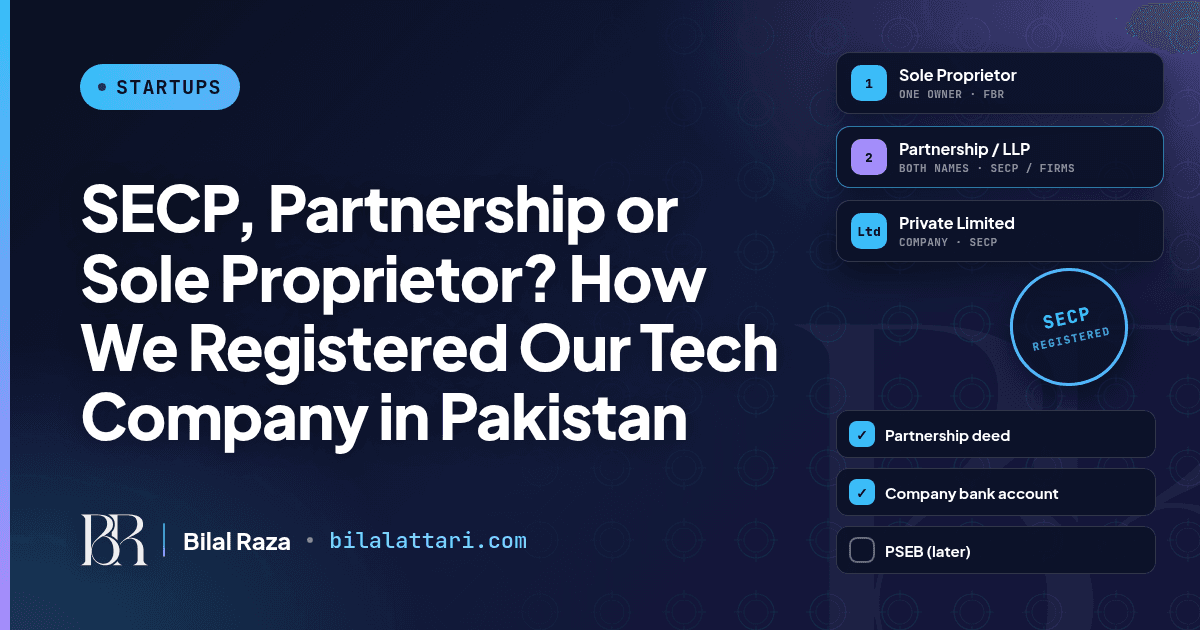
Mohammed Hussain was already running his own company. He is the CEO and founder of Boundless Technologies. When we decided to build something together, we both had a mutual understanding, and we chose a partnership so the company would be in both of our names. We registered it with SECP as a limited liability partnership (LLP). After that, we opened a bank account in the company’s name.
We have not registered with PSEB yet. That is a separate step, and I will come back to it below.
Sole proprietor, partnership firm, LLP or private limited
Before you pick, it helps to see the four common options side by side. The big thing most people miss: an ordinary partnership firm is not registered with SECP at all. It goes to the provincial Registrar of Firms under the Partnership Act, 1932. If you want SECP registration with two or more owners, the SECP vehicles are a limited liability partnership (LLP) or a private limited company.
| Sole proprietorship | Partnership firm | LLP | Private limited / SMC | |
|---|---|---|---|---|
| Law | No separate law; it is just you trading under a name | Partnership Act, 1932 | Limited Liability Partnership Act, 2017 | Companies Act, 2017 |
| Where you register | FBR for your NTN; no SECP registration | Provincial Registrar of Firms (not SECP) | SECP | SECP, online |
| Owners | One person | Two or more partners | Two or more partners | Two or more for private limited; one person for a single member company (SMC) |
| Separate legal entity? | No, the business is you | No | Yes | Yes |
| Liability | Unlimited, personal | Unlimited; partners are personally liable | Limited | Limited to shareholding |
| Good fit for | Solo freelancer starting out | Two people who want a simple deed | Partners who want SECP status and limited liability | Founders planning to hire, raise or sign bigger contracts |
Sole proprietorship
This is where most freelancers already are, whether they know it or not. You get an NTN from FBR and you are the business. It is simple and cheap, but there is no separation between you and the business, and you cannot really bring a partner into it.
Partnership firm
Two or more people sign a partnership deed. In Islamabad, for example, ICT Administration asks for Form-I, the deed on Rs. 1,000 stamp paper, a Rs. 1,000 fee deposited at NBP, an affidavit, an office address in a commercial area, and the partners’ CNICs, all notary attested. It is straightforward, but the partners carry unlimited personal liability.
LLP and private limited
Both are registered with SECP and both are separate legal entities with limited liability. An LLP keeps the feel of a partnership with SECP status. A private limited company (or a single member company if you are alone) is the usual choice once you plan to hire, sign larger contracts or bring in investors.
Why we chose a partnership
For us it came down to one thing: we wanted the company to belong to both of us. Neither of us was joining the other person’s business. We were starting something new together, and an LLP put both our names on it from day one. That made the conversations about ownership short, because there was nothing to negotiate later.
Pick a partner from a different field
This is the advice I give most often. When you decide to build a company with someone, the partner you choose should come from another field. If you are the technical person, a developer or a product engineer, then the other person should be a marketer, a business developer, or someone with a different skill set from yours.
Two developers will happily build forever and nobody will sell. Two sales people will sell things nobody can build. When your skills complement each other, you both work in your own lane, you respect what the other brings, and that is how you actually scale the company.
After registration: bank account first, PSEB later
Once the registration was done, the first practical step was a bank account in the company’s name. That is what makes the company real day to day. Client payments come into the business account, expenses go out of it, and your personal account stops being a mess of mixed money. If you are still figuring out how foreign payments reach Pakistan, my post on receiving freelance payments in Pakistan covers the personal side.
Where PSEB fits
PSEB (Pakistan Software Export Board) is not a replacement for SECP. It is a separate membership for IT and IT-enabled services exporters, and you need an existing registered business with an NTN before you apply through PSEB’s TechDestination portal. The main reason people do it is tax: PSEB’s own benefits page says registered companies pay 0.25% tax on IT export proceeds, compared with 1% for non-registered companies. Rates and rules change, so check the current page before you rely on that.
We have not done PSEB registration yet. It is on our list, but it was never the first step. Register the business, sort out the bank, then look at PSEB once export income is flowing.
| SECP (or Registrar of Firms) | PSEB | |
|---|---|---|
| What it is | Creates the legal business: company, LLP or firm | Pakistan Software Export Board membership for IT and IT-enabled services exporters |
| Required to exist? | Yes, this is the business registration itself | No, it is optional and comes on top |
| Needs first | Owners, name, address, deed or company documents | An existing registered business, NTN, bank account details and owners’ CNICs |
| Main draw | Business in its own name, bank account, contracts | Lower tax on IT export proceeds and other member benefits |
| Where we are | Done: registered with SECP as an LLP | Not done yet |
The order I would follow
- Agree on roles and ownership. Talk it through with your partner before any paperwork. Who builds, who sells, who owns what.
- Pick the structure. Alone and just starting: sole proprietor. Two people, simple setup: partnership firm. Want SECP status and limited liability: LLP or private limited.
- Register. Registrar of Firms for a partnership firm, SECP for an LLP or company.
- Get the NTN and open the business bank account. Keep business money separate from personal money from the first month.
- Look at PSEB if you export IT services. Do it once the business and bank are in place.
I wrote about the bigger picture, choosing a service and hiring slowly, in how to start a software house in Pakistan.
Wrapping up
We chose a partnership so the company is in both our names, registered it with SECP as an LLP, and opened a company bank account. PSEB is still ahead of us. If you take one thing from this post, let it be the partner advice: choose someone whose skills are different from yours, because that is what lets a small company grow.
If you are deciding between a sole proprietorship, a partnership or a company right now and want to talk it through, I am happy to share what I learned.
You can find me at bilalattari.com, email me at attari1235@gmail.com, or message me on LinkedIn.