You have been freelancing for a while. Clients keep coming back, a friend helps you on bigger projects, and one day you start wondering whether this could be a real company with a name, an office and a team. Then the questions pile up. Do I need to register? With whom? Should I hire first or find clients first? What if the work dries up after I hire someone?
I asked myself the same things. I started freelancing on Fiverr in 2019 and on Upwork in 2020, I have been teaching MERN stack at SMIT (Saylani Mass IT Training) since 2020, and in 2025 I co-founded 12Monday Technologies in Karachi with Muhammad Hussain. Today 12Monday does client software work and also builds its own products: 12Commerce, 12Bot, 12Pilot and 12Signature.
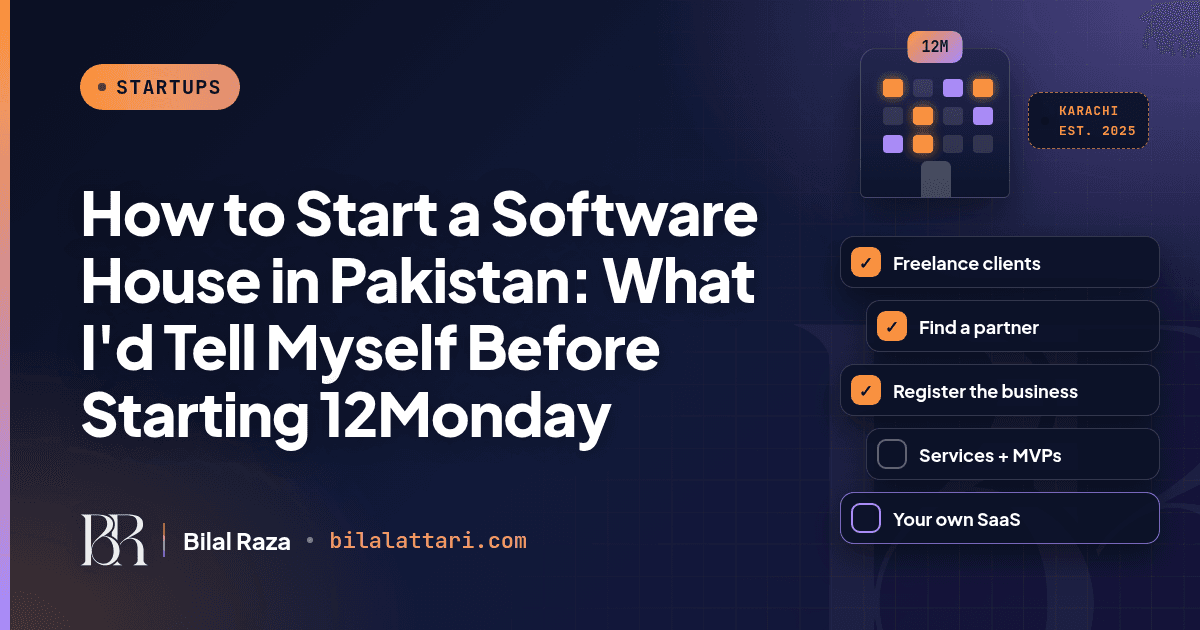
This post is what I would tell myself before starting a software house in Pakistan: the mindset shift, the legal basics, and the order I would do things in.
The short answer
Start a software house only after you have steady clients as a freelancer. Pick a narrow service you can deliver well, choose a legal structure that fits how many owners you have, register for tax, and hire slowly. Build your own products only once client work can pay the bills.
Most of the hard part is not the registration. It is moving from "I write the code" to "I make sure good code gets delivered on time, every time, even when I am not the one writing it."
Freelancer vs software house: what actually changes
Many developers think a software house is just freelancing with a bigger logo. It is a different job.
| Freelancer | Software house | |
|---|---|---|
| Who sells | You, under your own name and profile | A company name and a team, with you as one face of it |
| Who delivers | You do every part of the work | Different people handle design, code, testing and support |
| Typical work | Tasks, fixes and small projects | Full products, MVPs and ongoing contracts |
| Your main job | Writing code | Finding work, setting process and keeping quality steady |
| Biggest risk | Income stops when you stop | Salaries and rent are due even in a slow month |
If you still enjoy writing code more than anything else, that is fine. It may mean you need a partner who enjoys selling and managing, or that freelancing is the better fit for now.
Step 1: Prove demand before you build a company
Freelancing is the cheapest way to test whether people will pay you. Before you spend money on an office or salaries, you want proof that clients find you, pay you and come back.
What I would look for first
- Repeat clients, not only one-off orders.
- More work than you can handle alone, at least some of the time.
- A type of project you deliver again and again, such as React Native apps, MERN dashboards or e-commerce stores.
If you are not there yet, spend another few months on your freelancing profile and portfolio. A company will not fix a pipeline that does not exist.
Step 2: Choose a narrow service and say it clearly
"We do web, mobile, AI, design and marketing" sounds big, but it makes you look like everyone else. Clients remember a clear promise.
At 12Monday, one of the clearest things we say is that we can build an MVP in 15 days. A specific offer like that is easier to explain, easier to price and easier for a client to say yes to than a long list of services.
How to pick yours
Look at the projects you have already delivered and enjoyed. Pick the one where you are fastest and where clients were happiest, and build your first offer around it. You can widen the list later.
Step 3: Pick a legal structure
You do not need a lawyer to understand the options, but you should understand them before you sign contracts or open a business bank account. Here are the common structures in Pakistan:
| Structure | Where you register | Owners | Liability |
|---|---|---|---|
| Sole proprietorship | FBR (an NTN through the IRIS portal) | One person | The owner is personally liable |
| Partnership (AOP) | A partnership deed, which can be registered with the provincial Registrar of Firms, plus an NTN for the firm | Two or more partners | Partners are personally liable |
| Single member company (SMC) | SECP, online through eZfile | One person | Limited to the company |
| Private limited company | SECP, online through eZfile | Two or more members | Limited to the company |
Company incorporation with the SECP (Securities and Exchange Commission of Pakistan) is fully online now. SECP's own guidance says any two or more people can form a private company, and one person can form a single member company. Name reservation and incorporation are done through its eZfile portal, and the certificate of incorporation is sent by email.
How I would decide
- If you are one person testing the idea, a sole proprietorship or a single member company keeps things simple.
- If you have a co-founder, write down who owns what and who does what before you register anything. A partnership deed or company shareholding should match that agreement.
- If you plan to sign large contracts or bring in investors later, a private limited company is usually the cleaner long-term choice.
Rules and fees change, so check the official SECP and FBR pages on the day you register, and talk to a tax adviser for anything involving tax.
Step 4: Register for tax, and look at PSEB
Whatever structure you choose, you will need an NTN (National Tax Number) from FBR. Banks, clients and payment platforms will ask for it.
If you export IT services, also look at PSEB (Pakistan Software Export Board) registration. It is a separate registration on top of SECP and FBR, not a replacement for them. Applications are now made through PSEB's TechDestination portal, where there are separate categories for companies, call centres and freelancers. For a company or firm, PSEB lists documents such as the business NTN, a bank account certificate and the owners' CNICs, and registration is renewed every year.
Step 5: Hire slowly and write your process down
Your first hire changes everything, because now someone's salary depends on you finding work. I would hire only when there is more confirmed work than you can deliver, not when you hope there will be.
What to set up before the first hire
- A simple project process: how a request becomes tasks, who reviews code, and how you hand over to the client.
- Shared tools for code, tasks and communication, so knowledge does not live only in your head.
- A clear rule for client communication: who talks to the client, and how often.
Teaching at SMIT has shown me that many good junior developers are looking for their first real project. A small team of juniors with a clear process and careful code review can do solid work, but only if someone senior is actually reviewing.
Step 6: Build your own products, but not first
Every software house dreams of its own SaaS. At 12Monday we build products like 12Commerce for online stores, 12Bot for WhatsApp customer communication and 12Pilot for LinkedIn outreach, alongside client work.
My advice is to let client work pay for product work, not the other way around. Client projects also show you which problems businesses keep paying to solve, and those problems are often your best product ideas.
Wrapping up
Starting a software house in Pakistan is less about paperwork and more about readiness. Prove demand as a freelancer, choose a narrow service, pick a structure that matches your ownership, register with FBR and look at PSEB if you export, and hire only when the work is already there.
If you are a freelancer thinking about turning your work into a company, or you need a team to build your MVP, I would be happy to talk.
You can find me at bilalattari.com, email me at attari1235@gmail.com, or message me on LinkedIn.