You have finished your course at SMIT. You have built your projects, cleared your assignments and maybe got your certificate. And now comes the question every batch asks me: what do I do next? Should I look for a job, open a Fiverr account, start my own agency, or keep learning one more framework?
I have been a Lead MERN Trainer at Saylani Mass IT Training (SMIT) since 2020, I have been freelancing on Fiverr and Upwork since 2019, and today I run 12Monday Technologies with my partner. I have seen students leave the course and grow fast, and I have seen students get stuck for months. So here is the advice I give my own students when the course ends.
The short answer: get a job or real work first
My view is simple. After the course, your first step should be getting a job, or doing freelancing work somewhere. Do not sit at home waiting until you feel "ready". Real work is what makes you ready.
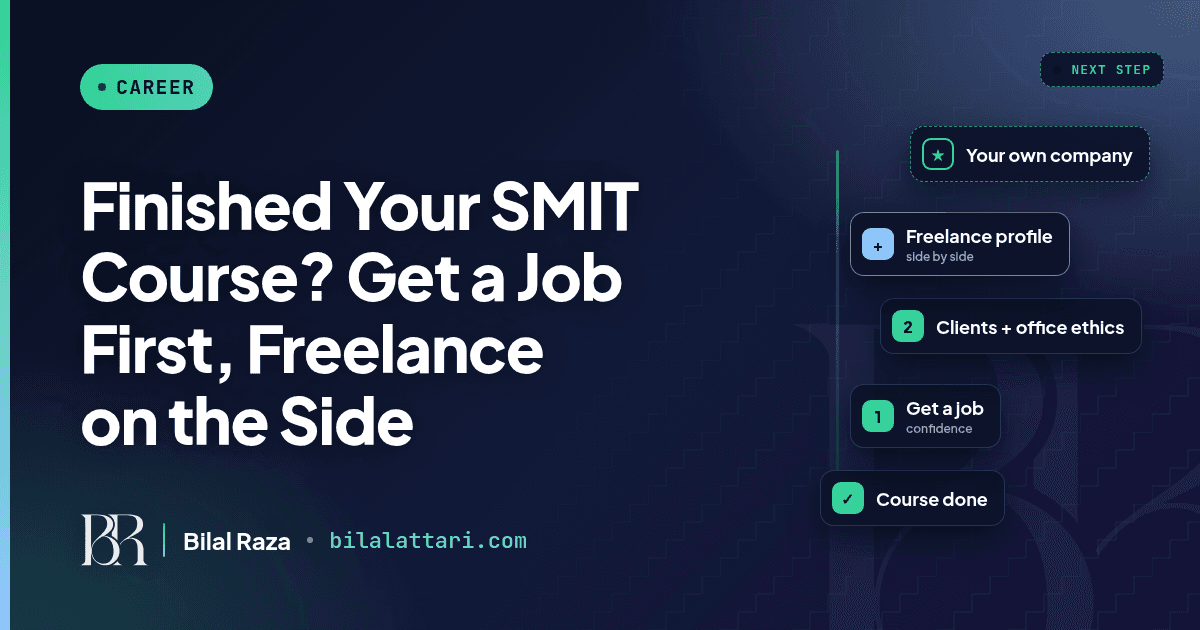
If you can get a job, take it. A job gives you confidence. It teaches you how to interact with clients, how office ethics work, and all the small things a course cannot teach you. And side by side, you should prepare your freelance account, so that later it is easy to take freelance clients or start your own company.
That is the whole plan: a job for experience and confidence, and a freelance profile built quietly on the side.
Why a job first
A course teaches you how to write code. A job teaches you how to deliver software to people who are paying for it. Those are different skills, and the second one is what clients actually pay for.
Confidence
Most fresh students doubt themselves. They know React and Node.js, but they are not sure they can handle a real project. Shipping features in a real codebase, with real deadlines, removes that doubt faster than any tutorial. After a few months you stop asking "can I do this?" and start asking "how long will this take?"
How to deal with clients
In a company you see how seniors talk to clients: how they ask for requirements, how they say no politely, how they explain a delay, how they handle a change request. You learn this by watching and by joining calls. When you later freelance, you already know how these conversations go, instead of learning it on your first paying client.
Office ethics
Coming on time, updating your team, owning your mistakes, respecting deadlines, communicating before a problem becomes big. None of this is in the syllabus, but it decides whether people want to work with you again. Freelance clients notice it just as much as employers do.
A job vs freelancing straight after the course
Some students skip the job and go straight to freelancing. It can work, but you are learning everything alone. Here is how the two paths compare in practice:
| A job first | Freelancing straight away | |
|---|---|---|
| Who finds the work | The company brings the projects and gives you tasks | You find every client yourself |
| Talking to clients | You learn by watching seniors, joining calls and handling small updates | You are the only person talking to the client, from the first message |
| Feedback on your code | Seniors review your work and point out mistakes | Mostly the client's reaction, often only when something breaks |
| Income | A fixed salary every month | Changes from one order to the next |
| What you learn besides code | Office ethics, deadlines, teamwork, reporting to someone | Selling, pricing, revisions, handling difficult clients alone |
| Confidence | Builds steadily as you ship real work with support around you | Can grow fast, or break after one bad client |
Neither path is wrong. But if you have the option, the job gives you a safer place to make your first mistakes.
Prepare your freelance account side by side
This is the part most students skip. They get a job, get comfortable, and two years later they want to freelance or start a company but have nothing ready: no profile, no portfolio, no reviews. Do not wait. Build it slowly while you work.
Make your GitHub look like a portfolio
Your course projects are your first portfolio. Clean them up, deploy them, and add a short profile README so a client understands who you are in ten seconds. Something like this is enough to start:
# Hi, I'm Ali, a MERN Stack Developer from Karachi
I build web apps with React, Next.js, Node.js, Express and MongoDB.
## Projects
- **Clinic Booking App**: React + Node.js + MongoDB. [Live demo](https://example.com) | [Code](https://github.com/you/clinic-app)
- **Store Admin Dashboard**: Next.js + Firebase. [Live demo](https://example.com) | [Code](https://github.com/you/store-admin)
## Currently
- Working as a junior developer
- Open to small freelance projects on weekends
## Contact
you@example.com | linkedin.com/in/you
Keep it honest. Only list projects you actually built, and link to live demos that work.
Set up your Fiverr or Upwork profile properly
Write a clear title, a short description of what you build, and gigs or a profile focused on one or two services you are genuinely good at. I wrote about this in detail in how to get your first order on Fiverr as a developer.
Sort out payments early
Open a bank account in your own name with your home address, so there are no problems when you connect it to Payoneer or your freelance platform later. I explained the full process in how to receive freelance payments in Pakistan.
Respect your job while you do it
Build your freelance side on your own time, not during office hours, and check your company's policy on outside work. Doing good work at your job is part of your reputation too. Many of your future clients and partners will come from people who saw how you work.
What the plan looks like side by side
| Side by side | What you do |
|---|---|
| At the job | Ship real features, ask questions, join client calls when you can, learn how the team plans and delivers |
| On your own time | Build your GitHub, deploy two or three projects, write your Fiverr or Upwork profile, set up a bank account in your own name |
| When you are ready | Take your first freelance clients, or use your experience and contacts to start your own company |
The point is that when the opportunity comes, you are ready for it. Your profile exists, your portfolio is live, your payments are sorted, and you already know how to talk to a client.
Common mistakes I see after the course
Waiting to feel ready
Many students keep learning "one more thing" before applying anywhere. You will never feel fully ready. Apply, take the work, and learn on the job.
Refusing a job because the salary is low
Your first job is paid partly in money and partly in experience. Confidence, client handling and office ethics are worth a lot at the start of your career.
Leaving freelancing for "later"
A freelance profile takes time to build. If you start it only when you need it, you start from zero at the worst moment.
Starting a company with no experience
Starting your own company is a great goal, and it is exactly where this plan leads. But it is much easier when you have already seen how a team delivers projects and how clients behave. I shared more about that path in how to start a software house in Pakistan.
Wrapping up
After your SMIT course, get a job or real freelance work as your first step. Let the job build your confidence, your client skills and your office ethics, and use your own time to prepare your freelance profile so that taking clients or starting your own company later is easy.
If you are a student who just finished the course and you are not sure what to do next, send me your GitHub or your profile and tell me where you are stuck. I am happy to point you in the right direction.
You can find me at bilalattari.com, email me at attari1235@gmail.com, or message me on LinkedIn.