You read the Quran every day, maybe for years, but the moment someone asks what a single ayah actually says word by word, you go quiet. You want to understand the Arabic yourself, not only through a translation. Then you search for a course and find long programmes, paid classes and books written for madrasa students. It is easy to give up before you start.
I come from a Dars-e-Nizami background, and today I build Islamic learning apps at Islamic Desk, including Sarf ki Dunya and Nahw ki Dunya. I have watched many people try to learn Quranic Arabic grammar, and the ones who make progress are rarely the ones with the most expensive course. They are the ones who follow a clear order and stay consistent.
This post is the step-by-step path I would give a friend who wants to learn Quranic Arabic grammar for free, using resources that are actually free today.
The short answer
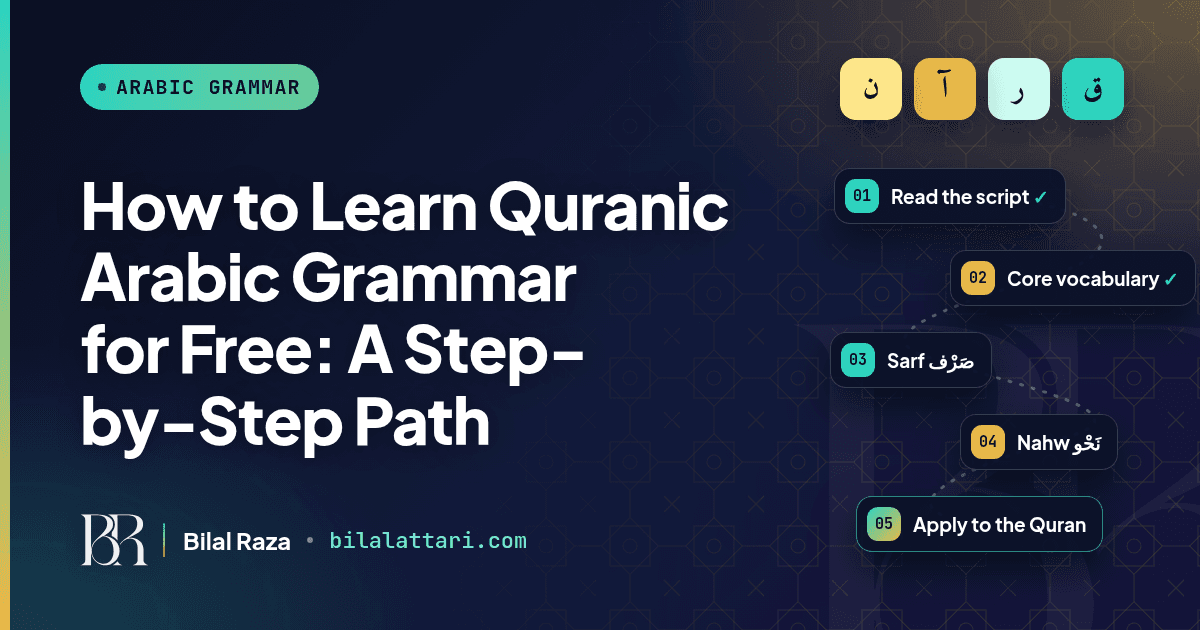
Learn it in this order: the Arabic script and reading, then a small core vocabulary, then Sarf (how words are formed), then Nahw (how sentences work), and then apply both to the ayaat you already recite. Spend 20 to 30 minutes a day, and use a teacher whenever you can, even if your main material is free.
The most common mistake is jumping straight into Nahw or into a big grammar book. Without Sarf you cannot even recognise which word you are looking at, so the rules never stick.
Sarf vs Nahw: why the order matters
Quranic Arabic grammar is traditionally split into two sciences. I wrote a full post on the difference between Sarf and Nahw, but here is the version you need for this path:
| Sarf (صرف) | Nahw (نحو) | |
|---|---|---|
| Studies | How a single word is built from its root and how its form changes | How words combine into a sentence and how word endings change |
| Example question | Is this word a past verb, a doer noun or a passive noun? | Is this word the subject, the object or something else? |
| Why order matters | Comes first: you need to recognise the word | Comes second: then you understand its role |
Step 1: Read the script with confidence
If you can already recite the Quran from the Arabic script, you have finished the hardest part of step 1. If you can only read slowly, keep reading daily until the letters and harakat (vowel marks) come without effort. Grammar is about patterns in words, and you cannot see patterns in words you are still decoding letter by letter.
Step 2: Build a small core vocabulary
Before any rules, start noticing the meaning of the words you recite. The free word-by-word view on Quran.com shows the meaning of each word under the ayah. Pick the surahs you recite in salah, such as Al-Fatiha and the short surahs of the last juz, and learn their words first.
A simple daily habit
Take one ayah a day. Read it, look at the meaning of each word, and write down any word you see again and again. Within a few weeks, you will start recognising the same roots in different places, and that is exactly what Sarf will explain.
Step 3: Learn Sarf (word formation)
Sarf teaches you how Arabic builds many words from one root. Once you know the patterns, a single root like ك ت ب opens up كَتَبَ (he wrote), كَاتِب (writer) and مَكْتُوب (written).
What to focus on
- The basic terms: root letters, past and present verbs, and doer and done-to nouns.
- The main verb patterns and their conjugation tables (sarf sagheer and gardan).
- Regular practice with quizzes, because conjugations only stick through repetition.
This is why we built Sarf ki Dunya. It has 90 definitions, 40 rules, more than 4,000 conjugations of 201 masdar, and 11 quizzes with 8 levels each, so you can practise a little every day on your phone. It also includes Sarf books in Arabic and Urdu.
Step 4: Learn Nahw (sentence structure)
Once you can recognise a word, Nahw tells you what that word is doing in the sentence. In كَتَبَ الطَّالِبُ الدَّرْسَ (the student wrote the lesson), Nahw explains why الطَّالِبُ is the doer (fa'il) and الدَّرْسَ is the object (maf'ul bihi), and why their endings differ.
What to focus on
- The difference between nouns, verbs and particles.
- Nominal and verbal sentences, and the subject and object.
- Case endings (i'rab) and the particles that change them.
Nahw ki Dunya covers this with notes, books in Arabic, Urdu, Farsi and English, vocabulary and chapter quizzes, plus badges and a leaderboard that make it easier to keep going.
Step 5: Apply it to the Quran
This is where the effort pays off. Take an ayah you already know and try to analyse it yourself: identify each word's root and form (Sarf), then its role in the sentence (Nahw). Then check your answer.
Free tools for checking your work
- The Seegha tool on Islamic Desk lets you research the forms of verbs used in the Quran.
- The Quranic Arabic Corpus gives word-by-word grammar, syntax and morphology for the Quran.
- The Kalimat list on Islamic Desk explains non-declinable words that confuse many beginners.
The free resources at a glance
| Free resource | What it is good for | When to use it |
|---|---|---|
| Quran.com word by word | Seeing the meaning of each word under the ayah | From day one, alongside your daily recitation |
| Sarf ki Dunya (app) | Sarf: definitions, rules, conjugation tables and quizzes | Stage 2, while you memorise verb patterns |
| Nahw ki Dunya (app) | Nahw: notes, books, vocabulary and chapter quizzes | Stage 3, once Sarf basics feel familiar |
| Islamic Desk Seegha tool | Looking up the form (seegha) of verbs used in the Quran | Stage 4, when you start analysing ayaat yourself |
| Quranic Arabic Corpus | Word by word grammar, syntax and morphology of every ayah | Stage 4, to check your own analysis |
| Islamic Desk books library | Free PDFs of classic Sarf and Nahw books | Any stage, with a teacher if you can |
Islamic Desk's own FAQ says most of its courses and resources are free, including the Q&A library, books, the Seegha tool and the mobile apps. The books library has free PDFs on Sarf, Nahw and Islamic studies, and the courses page groups lessons by app.
Tips that keep you going
Short and daily beats long and weekly
Twenty minutes every day will take you further than a three-hour session every Sunday. Grammar is memory work, and memory needs repetition.
Learn in the language you think in
If you think in Urdu, learn grammar in Urdu. Much of the classic Sarf and Nahw material taught in our madaris is available in Urdu, and there is no prize for struggling through an English textbook you only half understand.
Find a teacher for the hard parts
Free apps and books can carry you a long way, but a teacher can correct mistakes that you will not notice yourself. Use free material for daily practice and a teacher, or a study circle, for questions.
Wrapping up
You can learn Quranic Arabic grammar for free if you follow the right order: script, vocabulary, Sarf, Nahw, and then the Quran itself. Keep it daily, keep it small, and check your work against reliable tools.
If you are starting this journey, or you teach Arabic and want to use our apps with your students, I would love to hear from you.
You can find me at bilalattari.com, email me at attari1235@gmail.com, or message me on LinkedIn.