If you have started learning Arabic grammar, you have almost certainly heard two words: Sarf (صرف) and Nahw (نحو). People use them together so often that beginners think they are the same subject. They are not.
I founded Islamic Desk around 2020 to make Arabic grammar and Islamic studies easier to learn on a phone. We built two separate apps on purpose: Sarf ki Dunya for morphology, and Nahw ki Dunya for syntax. That choice came from how these subjects are taught in traditional pathways like Dars-e-Nizami, and from what students actually struggle with when both are mixed into one confusing pile.
Here is the difference in plain language, with simple examples, and a practical way to start.
The Short Answer
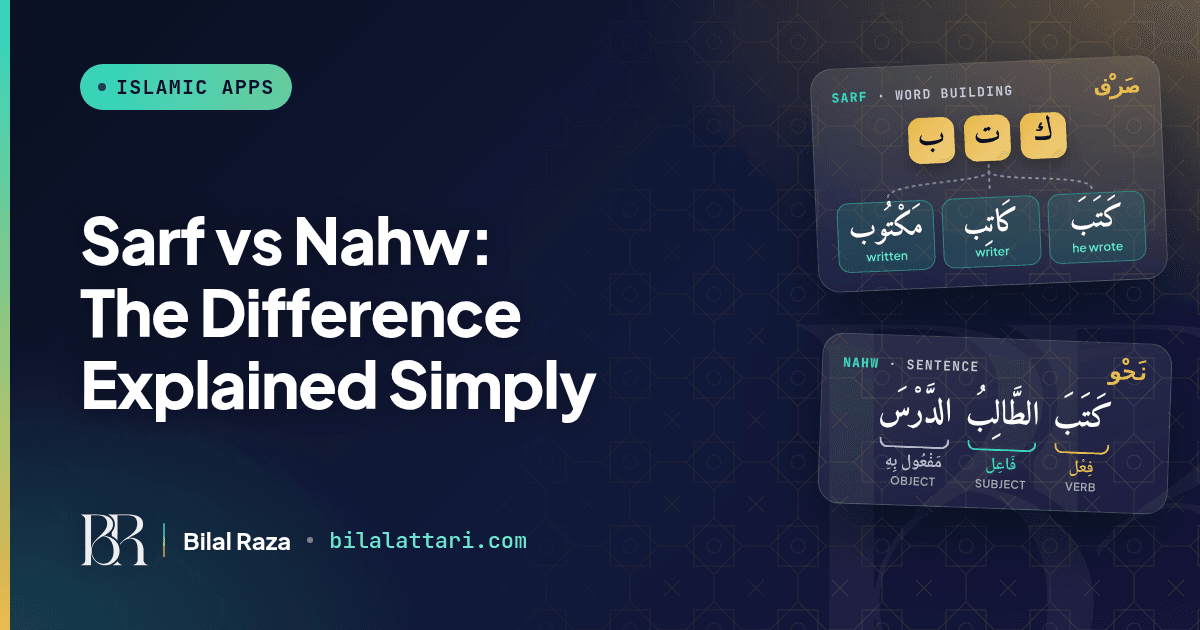
- Sarf is about the word. How one root turns into many forms: past, present, command, noun of the doer, noun of the object, and more.
- Nahw is about the sentence. How words sit together, what role each word plays, and why endings change (rafa', nasb, jarr).
A line I use with students: Sarf builds the bricks. Nahw builds the wall. You need both. But you learn them better when you know which problem you are solving.
| Sarf (صرف) | Nahw (نحو) | |
|---|---|---|
| What it studies | Morphology: the shape of one word | Syntax: how words work together in a sentence |
| Focus | The word: how one root turns into many forms (past, present, command, noun of the doer, noun of the object) | The sentence: what role each word plays and why endings change (rafa', nasb, jarr) |
| Question it answers | "Which form of the verb is this?" | "What is this word doing in the sentence?" |
| Example | كَتَبَ / يَكْتُبُ / اُكْتُبْ from the root ك ت ب | الطَّالِبُ يَكْتُبُ الدَّرْسَ: who writes, and what is written |
| In one line | Builds the bricks | Builds the wall |
| Our app | Sarf ki Dunya | Nahw ki Dunya |
What Is Sarf? (Morphology / Word Forms)
Sarf (صرف) is Arabic morphology. You start from a root, often three letters, and learn the patterns that grow from it. In classroom language this is where you meet masdar, gardan (conjugation drills), and tables that feel endless at first.
Take the familiar root ك ت ب (k-t-b), related to writing:
- كَتَبَ (kataba) — he wrote (past)
- يَكْتُبُ (yaktubu) — he writes / will write (present)
- اُكْتُبْ (uktub) — write! (command)
- كَاتِب (kātib) — writer (doer)
- مَكْتُوب (maktūb) — written / something written (object or result)
- كِتَاب (kitāb) — book
Same letters. Different shapes. Different meanings. That family of forms is Sarf territory.
When students say "I cannot memorise the gardan," they are usually stuck on Sarf, not on sentence parsing. Drill, repetition, and clear definitions help more than long theory talks.
What we put in Sarf ki Dunya
In Sarf ki Dunya we focus only on that world of word forms. On Google Play the app lists roughly 90 definitions, 40 rules, more than 4,000 conjugations across 201 masdar, and 11 quizzes with 8 levels each (880 questions). It also includes Sarf books in Arabic and Urdu. It has no ads, and the Play listing says it collects no data. As of late September 2026 it showed 50K+ installs and a 5.0 rating from about 507 ratings.
Play Store: Sarf ki Dunya · Product page: islamicdesk.com
What Is Nahw? (Syntax / Sentence Structure)
Nahw (نحو) is Arabic syntax. Once you have words, Nahw asks: who is doing what to whom, and how do the endings tell you that?
A simple sentence:
الطَّالِبُ يَكْتُبُ الدَّرْسَ
al-ṭālibu yaktubu ad-darsa
The student writes the lesson.
- الطَّالِبُ — the student (subject / doer; often marked with a damma in this kind of example)
- يَكْتُبُ — writes (the verb form you learned in Sarf)
- الدَّرْسَ — the lesson (object; often marked with a fatha in this kind of example)
Sarf already gave you yaktubu. Nahw places it in a sentence and explains why al-ṭālibu and ad-darsa look different at the end. Change the roles, and the endings can change with them. That is why Nahw feels like detective work: you are reading the signs on each word.
If Sarf answers "which form of the verb is this?", Nahw answers "what is this word doing in the sentence?"
What we put in Nahw ki Dunya
In Nahw ki Dunya the focus is notes, books (Arabic, Urdu, Farsi, and English), vocabulary, chapter quizzes, badges, and a leaderboard. On Google Play it also shows 50K+ installs (late September 2026). The Play listing notes that the app is presented with teachers and students of Jamia Tul Madina (DawateIslami).
Play Store: Nahw ki Dunya · Product page: islamicdesk.com
Why Two Apps Instead of One?
People often ask why we did not ship one "Arabic Grammar" app. Two reasons.
1. The subjects are different skills. Memorising a conjugation table and parsing a sentence use different muscles. When both live in one crowded product, beginners bounce between modes and feel behind in both.
2. Teaching tradition already separates them. In pathways like Dars-e-Nizami, Sarf and Nahw are taught as distinct sciences. I have spoken publicly about the jump from that background into building Islamic learning apps (including a HiringMine "After Taraweeh Tech Talks" session on the theme "From Dars-e-Nizami to Tech Founder"). Keeping the products separate respects how students already study.
Islamic Desk itself is a wider platform: free and low-friction resources where we can offer them (our FAQ says most courses and resources are free, including the Q&A library, books, Seegha tool, and mobile apps), plus courses, a Seegha tool for Qur'anic word forms, a books library, and an AI chat called Sarf Nahw GPT. The apps stay focused so a student can open the phone and practise one skill at a time.
A Simple Way to Remember the Difference
- Ask: Am I changing the shape of one word? → Sarf
- Ask: Am I explaining how words work together in a line? → Nahw
- Stuck on gardan / verb tables / masdar families? → start with Sarf
- Stuck on i'rab, subject and object, or why an ending changed? → start with Nahw
You will use both every time you read a Qur'anic ayah or a hadith with understanding. The order does not have to be perfect. What helps is knowing which door you are walking through today.
How I Would Start If I Were a Beginner Again
- Week 1–2 (Sarf): Learn one common root family (like k-t-b) across past, present, and command. Say the forms out loud. Short daily drills beat long weekend cramming.
- Week 3 (Nahw): Take three-word sentences. Label doer, verb, and object. Do not chase advanced terms until the simple pattern feels obvious.
- Ongoing: Read a short Arabic line, then ask both questions: which forms do I see (Sarf), and what is each word doing (Nahw)?
If Urdu is your comfort language, both apps include Urdu material so you are not forced to learn grammar only through English explanations. That matters for a lot of students in Pakistan and the diaspora.
Common Mix-Ups I Hear
- "Sarf and Nahw are just Arabic grammar." True as a bundle. Unhelpful as a study plan. Split the work.
- "If I master Sarf, Nahw will be automatic." No. Knowing yaktubu does not tell you who is writing what.
- "If I only study Nahw, I can skip the tables." Also no. Weak forms make every sentence feel like guesswork.
- "I need a paid course before I touch an app." Not necessarily. Many Islamic Desk resources are free, and the Play apps are a practical place to drill.
Wrapping up
Sarf and Nahw are partners, not twins. One shapes the word. The other shapes the sentence. I built two apps so learners could practise each skill without drowning in the other.
If this helped, share it with a classmate who keeps mixing the two terms. And if you are building your own Islamic learning product, or you want a second opinion on a mobile learning app, I am happy to talk.
You can find me at bilalattari.com, email me at attari1235@gmail.com, or message me on LinkedIn.