If you run a small shop in Pakistan and want to start selling online, Shopify is probably the first name you heard. Every tutorial uses it, it looks like the safe choice, and signing up takes a few minutes. What most people only find out later is what it really takes to keep that store running, and what it costs every month.
I am a MERN and React Native engineer, and I co-founded 12Monday Technologies in Karachi, where we build 12Commerce, a store builder for Pakistani sellers. So yes, I have a side in this debate, and I will say that clearly upfront. But my opinion on Shopify is not that it is bad. It is that it fits some businesses and not others.
In this post I will share my honest view on Shopify in Pakistan, what it actually costs, why small retailers struggle with it, and what I would suggest instead.
The short answer: great for large businesses, costly for small retailers
Here is my view in one line. Shopify is good for large businesses, but for a small retailer it is very costly, and they need Shopify developers and other help to make it work.
A large brand has the budget for the monthly plan, the paid apps, and a developer who knows Shopify. For them, Shopify is a strong, proven platform. A small retailer in Pakistan selling clothes, cosmetics or home-made food is in a very different position. Every dollar subscription matters, and there is usually nobody on the team who can customise a Shopify theme.
Does Shopify work in Pakistan?
Yes, you can open a Shopify store from Pakistan. Shopify says it is available in nearly every country. The catch is payments.
Shopify Payments is not available
Shopify Payments, Shopify’s own built-in payment system, only works for businesses in the countries on its supported list, and Pakistan is not on that list when I checked. Shopify’s help centre says that if your country isn’t listed, you need to use a third-party payment provider.
Cash on delivery works as a manual method
Most Pakistani stores still run on cash on delivery, and Shopify does support COD as a manual payment method. Shopify says you are not charged third-party transaction fees for manual payments. The order comes in as unpaid, and you mark it paid once the rider collects the cash. I wrote more about this choice in cash on delivery vs online payment gateways in Pakistan.
Online payments mean an extra fee
If you want card or wallet payments, you connect a local gateway through a third-party provider. JazzCash, for example, lists Shopify among its plugins. But when you use a third-party provider instead of Shopify Payments, Shopify adds its own transaction fee on top of whatever the gateway charges.
What Shopify actually costs
These are the prices on Shopify’s pricing page when I checked in October 2026. Shopify shows them in US dollars, and prices can differ by region and change over time, so check the page on the day you decide.
| Basic | Grow | Advanced | |
|---|---|---|---|
| Pay monthly | $39 USD/mo | $105 USD/mo | $399 USD/mo |
| Pay yearly | $29 USD/mo | $79 USD/mo | $299 USD/mo |
| Fee when you use a third-party payment provider | 2% | 1% | 0.6% |
| Staff accounts | None extra | Up to 5 | Up to 15 |
Shopify currently offers a 3-day free trial and then $1 per month for the first 3 months on most plans. After that, the normal price starts. Because the plan is priced in dollars, the rupee amount you pay moves with the exchange rate every month.
The plan is only the start
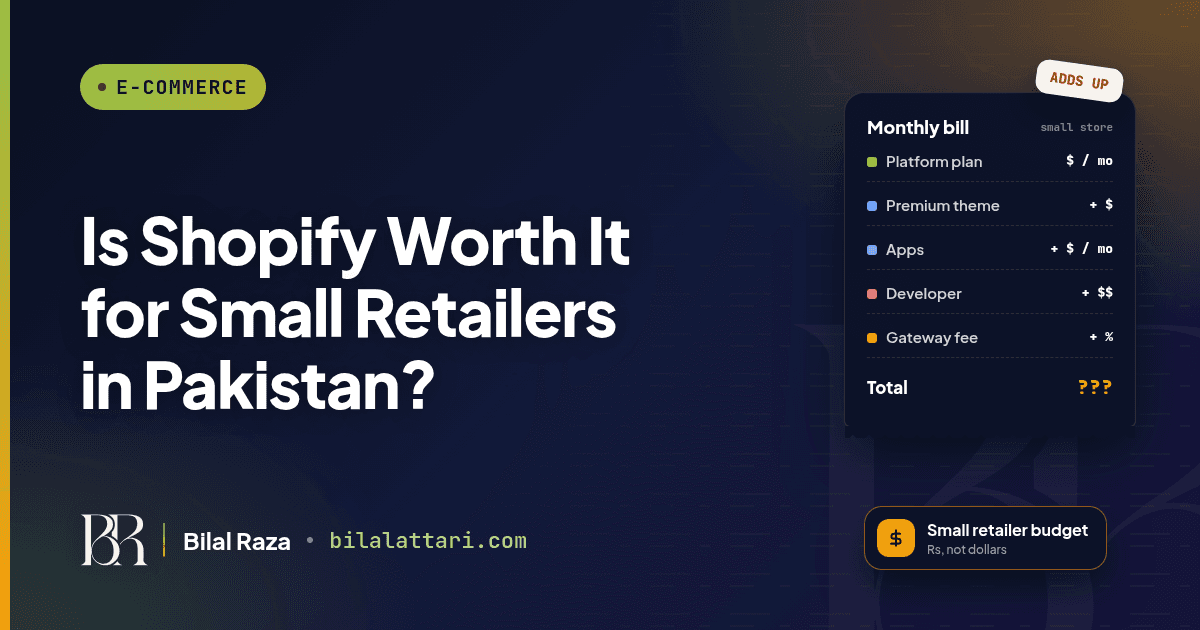
The monthly plan is the number everyone sees. What small retailers don’t see at the start is everything that gets added later: a premium theme, apps for things like reviews, WhatsApp buttons or extra features, each with its own monthly charge in many cases, plus the third-party payment fee if you go online.
Why small retailers struggle with Shopify
When you put a large business and a small retailer side by side, the same platform feels completely different.
| Large business | Small retailer | |
|---|---|---|
| Monthly plan in dollars | A small line in the budget | Can be more than the store makes in a slow month |
| Third-party payment fee | Lower on higher plans | Highest on Basic (2%), on top of the gateway’s own charges |
| Paid themes and apps | Budgeted as a normal cost | Every extra subscription hurts |
| Shopify developer | Often has one in-house or on retainer | Has to hire one for every change |
| Who runs the store day to day | A team | Usually the owner, alongside everything else |
You need a Shopify developer
This is the part people underestimate. Shopify themes are built with Liquid, Shopify’s own template language. Changing a layout, fixing a checkout detail, or making the store look the way you imagined usually needs someone who knows Shopify specifically. A general web developer or the shop owner’s nephew who "knows computers" often can’t do it properly.
So the small retailer ends up paying the plan, paying for apps, and then paying a Shopify developer every time something needs to change. That is what I mean when I say they need Shopify developers and other things to make it work.
Dollar costs, rupee sales
A small Pakistani store earns in rupees, often in small orders paid by cash on delivery. Its costs on Shopify are in dollars. In a slow month the store still pays the full subscription and every app, whether it sold ten orders or a hundred.
What I would suggest instead
If you are a large brand with a budget and a team, Shopify is a good choice and I would not talk you out of it. If you are a small retailer, start with something that matches your size, your currency and the way you already sell.
Start local and start small
This is exactly why we built 12Commerce. Pricing is in rupees, there is a 30-day free trial, and it works as widgets you can embed into a website you already have, with WhatsApp ordering as part of the core flow. Today 12Commerce stores run on cash on delivery, and other payment methods can be integrated if a seller has them. You can see the current plans on the 12Commerce pricing page.
| Shopify | A local store builder like 12Commerce | |
|---|---|---|
| Pricing currency | US dollars on the pricing page | Pakistani rupees |
| Trial | 3 days free, then $1/month for 3 months on most plans | 30-day free trial |
| Payments in Pakistan | Shopify Payments not available; third-party provider or manual methods like COD | Cash on delivery today; other methods can be integrated if the seller has them |
| Existing website | Store usually becomes the website; Buy Button for external sites | Widgets embed into the site you already have |
| Best fit | Larger brands that want the global app ecosystem | Small Pakistani sellers starting on a rupee budget |
Questions to ask before you choose
- What will I pay every month in total, not just for the plan, but for the theme, apps and payments?
- Who will make changes to the store? If the answer is "I will hire someone", add that cost too.
- How do my customers pay? If most of them pay cash on delivery, you may not need an online gateway on day one.
- Do I already have a website or a WhatsApp customer base? Then you may not need to rebuild anything.
Our team has written a fuller product comparison on the 12Commerce blog: 12Commerce vs Shopify for Pakistani stores. If you are just getting started, my post on starting an online store in Pakistan with little or no investment walks through the first steps.
Wrapping up
Shopify works in Pakistan and it is a strong platform for large businesses. For small retailers, the dollar plans, paid apps, extra payment fees and the need for a Shopify developer add up quickly. Choose the platform that fits the size of your business today, not the one with the biggest name.
If you are deciding between Shopify and a local option for your store and want a second opinion, send me a message and I will tell you honestly what I would do in your place.
You can find me at bilalattari.com, email me at attari1235@gmail.com, or message me on LinkedIn.