Most of us want to know the Seerah properly. We love the Prophet ﷺ, we hear pieces of his life in Friday khutbahs and in Rabi ul Awwal gatherings, but if someone asks us to tell his life story in order, from Makkah to Madinah, a lot of us get stuck after the first few events.
The problem is usually not intention. It is time. You have a job, a family, kids asking questions, and a phone full of notifications. A thick Seerah book sits on the shelf with a bookmark on page 40.
I am Bilal Raza, a software engineer in Karachi and the founder of Islamic Desk. One of the apps we built there is Seerat ki Dunya, made for exactly this problem: helping ordinary people learn the Seerah a little every day. Building it forced me to think hard about how busy adults and kids actually learn. This post is the simple path I would suggest to a friend, whether or not they ever use our app.
The short answer: big picture first, then one theme at a time
If you remember one thing, remember this order:
- Learn the timeline of his life ﷺ from start to end, at a high level.
- Go deep into one theme at a time: his character, his family life, his worship, his leadership, the Hajj, the battles.
- Turn each lesson into one small action the same day.
- Keep a daily connection through Durood, even on days you learn nothing new.
Most people do it the other way around. They jump into one detailed topic, get lost because they do not know where it sits in his life, and give up. The timeline is the map. Everything else hangs on it.
Step 1: Build the timeline in your head
Before details, you need the skeleton. You should be able to place any event you hear about into the right period of his life ﷺ.
The main stops
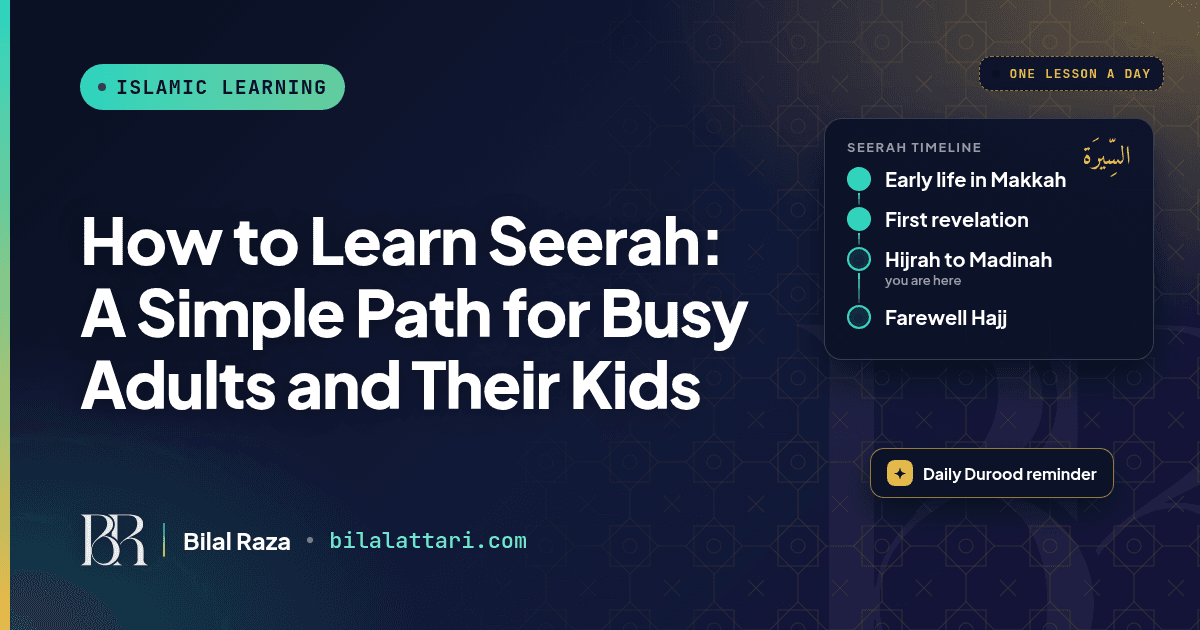
Keep it simple at first: his early life in Makkah, the first revelation, the years of calling people to Islam in Makkah, the Hijrah to Madinah, the Madinan years with the battles and treaties, and the Farewell Hajj. Once these are clear, every new story you hear has a place to go.
Use a visual timeline
A timeline you can see helps far more than a list. In Seerat ki Dunya we added Seerah Maps for this reason: the major events of his life laid out with his age and the Hijri year, so you can see what happened before and after. If you prefer paper, draw one line across a page and mark the events as you learn them. It works.
Step 2: Go deep, one theme at a time
With the map in place, pick one theme and stay with it until it feels familiar. Themes are easier to finish than a whole biography, and finishing builds the habit.
Good themes to start with
His character and manners (the Shama'il) are a beautiful first theme, because they touch daily life straight away. After that, his social and family life, his worship, his leadership, and the journey of the Hajj. On Islamic Desk our Seerah courses are organised this way, with separate courses on topics such as his social life, his leadership, his worship, his Hajj and the Battle of Badr, so learners can take one theme at a time.
Choose your format
There is no single right format. Here is how I think about the three common ones:
| A full Seerah book | A structured course | A daily app habit | |
|---|---|---|---|
| Best for | Depth and the full story in order | One topic studied properly, with a teacher | Consistency on busy days |
| Weak spot | Easy to drop halfway | Needs set time each week | Can stay shallow if it is all you do |
| How I would use it | Read alongside, a chapter at a time | Pick one theme at a time, like his family life or leadership | The daily anchor: lesson, Sunnah task, Durood |
If you want one book to read alongside, Ar-Raheeq Al-Makhtum (The Sealed Nectar) by Safiur Rahman Mubarakpuri is a well-known one-volume Seerah that won first prize in the Muslim World League's Seerah competition in 1979. Read it a chapter at a time next to your daily lessons, not instead of them.
Step 3: Turn every lesson into one small action
The Seerah is not only history. It is how he ﷺ lived, so the best test of whether you learned something is whether it changed something you did today.
This is why Seerat ki Dunya has Mini Sunnah Tasks: small daily actions like greeting with salaam, using the right hand, and showing gratitude. They sound small, and that is the point. A small action done today beats a big plan for next month.
A simple rule I like: after each lesson, write one line in your notes app. "Today I learned X. Today I will do Y." That one line turns reading into practice.
Step 4: Keep a daily connection through Durood
Some days you will not have time for a lesson. That is fine. Keep the connection alive with Durood. In the app we show a new Durood every day with a gentle reminder notification, because a reminder at the right moment is often all a busy person needs.
We also learned something about motivation here. When we moved the Durood leaderboard from inside the profile screen to the bottom tab, people engaged with it much more. I wrote about that change in how moving one feature to the bottom tab changed our Durood numbers. Seeing others recite encourages you to keep going too.
How to teach the Seerah to your kids
Kids learn the Seerah best through stories, not dates. Start with who he ﷺ was as a person: honest, merciful, gentle with children. The timeline can come later.
Keep it short and do it together
Ten minutes together beats an hour alone with a screen. Tell or watch one story, then ask them to tell it back to you in their own words. If they can retell it, they learned it.
Make it a game, but keep it clean
Seerat ki Dunya has a Seerah for Kids section with games, cartoons and rewards, because kids stay longer when learning feels like play. Whatever app you use for your children, check its Play Store listing first. Look at whether it shows "Contains ads" and read the Data safety section. Seerat ki Dunya's Play listing does not show a "Contains ads" label, and its Data safety section says no data is collected or shared.
Here is how the path looks side by side for you and your child:
| Busy adult | Child (with a parent) | |
|---|---|---|
| Daily time | One short lesson, about the length of a tea break | A story or a short video, then a chat about it |
| Starting point | The full timeline first, then one theme at a time | Simple stories: his kindness, his honesty, how he treated children and animals |
| Practice | One Sunnah a day, plus Durood | One small Sunnah together, like saying salaam or using the right hand |
| Checking yourself | A quiz at the end of each chapter | Games and rewards, plus "tell me the story back" |
| Main risk | Starting a thick book and stopping at page 40 | Too much screen time, or lessons that feel like homework |
Mistakes I see people make
Starting with the hardest book
A detailed, multi-volume work is wonderful later, but as a first step it often ends in a bookmark and guilt. Start light, build the habit, then go deeper.
Learning without checking
Reading feels like learning, but you only know you remember it when you are tested. That is why every course in our app ends chapters with quizzes. Even a friend asking you three questions works.
Wrapping up
Learning the Seerah as a busy adult is very doable if you get the order right: the timeline first, then one theme at a time, one small Sunnah a day, and Durood to keep the connection on days with no time. For kids, use short stories, do it together, and choose apps carefully.
If you want to try our way of doing it, Seerat ki Dunya is free on Google Play, and our Seerah courses are on Islamic Desk. I would love to hear what helps you and your family stay consistent, or what you wish an app like ours did better.
You can find me at bilalattari.com, email me at attari1235@gmail.com, or message me on LinkedIn.
Sources
- Seerat ki Dunya on Google Play (features, ads label and Data safety, checked 22 Oct 2026)
- seeratkidunya.com (Seerah Timeline, Shamail, Seerah for Kids)
- Islamic Desk courses
- Ar-Raheeq Al-Makhtum on Wikipedia