"Koi aisi app batayein jis se Arabic grammar Urdu mein seekh sakoon." I get some version of this message often. Most people asking are not beginners in effort. They have tried a YouTube playlist, downloaded two or three apps, and given up because the explanations were in English, the lessons jumped around, or the app was full of ads.
I am a React Native developer and the founder of Islamic Desk, where we build Sarf ki Dunya and Nahw ki Dunya, two apps for learning Arabic grammar. So I have seen this problem from both sides: as someone who wants students to learn properly, and as someone who has to decide what goes on every screen. In this post I will share what I think you should look for in an Arabic grammar app if you learn best in Urdu, and then, honestly, where our own apps fit and where they do not.
The short answer
A good Arabic grammar app for Urdu speakers keeps Sarf and Nahw clearly separate, explains in Urdu while keeping the real Arabic terms, makes you practise with quizzes instead of only reading, gives you full conjugation tables, and has books for when you want to go deeper. It should also respect your focus: no ads in the way and no unnecessary data collection.
And one thing no app can fix: it is a practice and revision tool. It works best next to a teacher or a proper course, not instead of one.
Why learning Arabic grammar in Urdu makes sense
If Urdu is the language you think in, learning grammar through it simply removes one layer of translation. You are already learning a new set of rules. You should not also be decoding English explanations at the same time.
You already know more Arabic than you think
Urdu has taken a lot of vocabulary from Arabic. Words like kitab (book), ilm (knowledge) and qalam (pen) are Arabic words you use every day. When an Urdu explanation connects a new rule to a word you already know, it clicks much faster.
But keep the Arabic terms
A good Urdu explanation still uses the real terms: fi'l, fa'il, maf'ul bihi, masdar, sigha. Your teacher, your books and every classical text use them. An app that replaces them with its own labels will make the next step harder for you.
What to look for in an Arabic grammar app
Here is the checklist I would use myself before downloading anything. You can go through it in a couple of minutes on the store page.
| What to check | Why it matters | How to check in two minutes |
|---|---|---|
| Sarf and Nahw kept clear | Mixing word forms and sentence structure is the fastest way to get confused | Look at the lesson list. Can you tell which part is Sarf and which is Nahw? |
| Urdu explanations, Arabic terms kept | You understand faster in Urdu, but you still need the real terms for class and books | Open one lesson and see if terms like fi'l, fa'il and masdar are still there |
| Practice, not just reading | Grammar sticks when you test yourself, not when you scroll | Look for quizzes with levels and a way to see your progress |
| Conjugation tables (gardan) | Sarf is built on patterns you have to see again and again | Check if it shows full conjugations, not just a few examples |
| Books for depth | An app is short by design. At some point you need the actual text | See if there is a library section with Arabic and Urdu books |
| Ads and data | You will open it daily. Ads and tracking get in the way of focus | On Google Play, look for the "Contains ads" label and read the Data safety section |
| Who made the content | Grammar mistakes in an app get memorised, which is worse than not learning | Read the description and developer page. Are teachers or scholars involved? |
Sarf and Nahw should not be mixed up
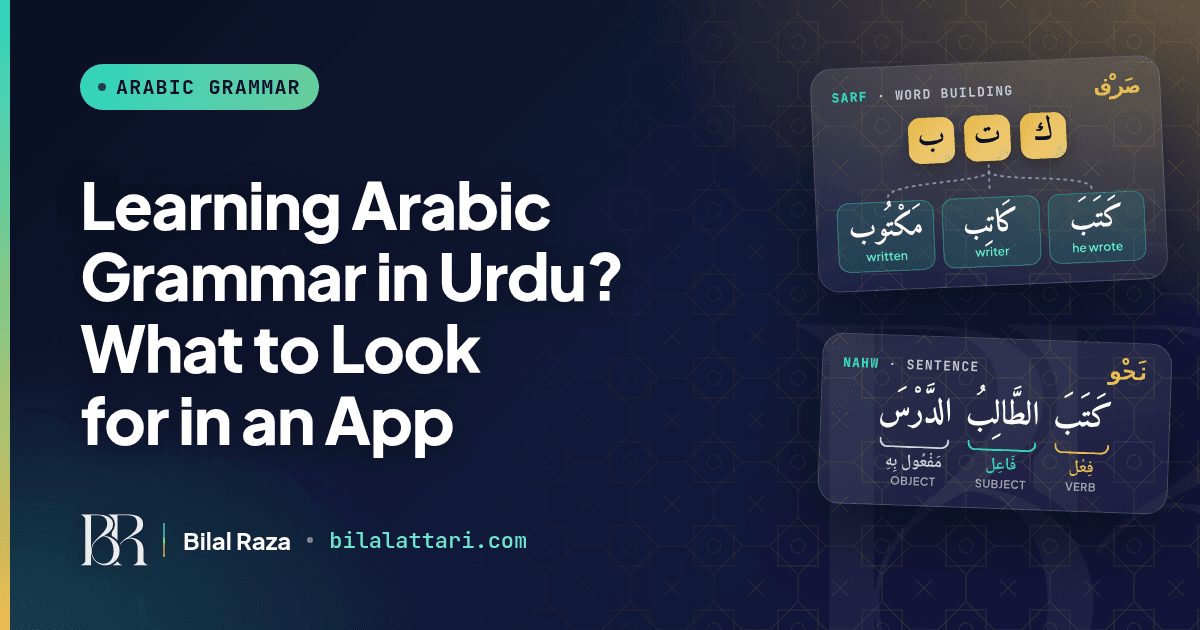
Sarf is about the word: how one root becomes many forms and how each form changes the meaning. Nahw is about the sentence: who did the action, what it happened to, and how the endings show that. If you are not sure about the difference yet, I explained it in Sarf vs Nahw: the difference explained simply. An app that jumbles both together usually leaves students knowing a bit of everything and nothing properly.
Practice is where learning happens
Reading a rule takes thirty seconds. Being able to use it takes many rounds of getting it wrong and then right. Look for quizzes that are split into levels, so you can see where you are and come back to what you missed.
Check ads and data on the store page
You are going to open this app every day, often for ten minutes at a time. A full-screen ad after every quiz breaks your focus. On Google Play, the store page shows a "Contains ads" label if an app has ads, and the Data safety section tells you what the app collects and shares. It takes one scroll to check.
Where our apps fit
We built two separate apps on purpose, one for each branch, so each one can go deep instead of covering both lightly. Here is what each one actually has, based on their Google Play listings.
| Sarf ki Dunya | Nahw ki Dunya | |
|---|---|---|
| Branch it teaches | Sarf: how Arabic words change form and how that changes meaning | Nahw: how words work together in a sentence |
| Core content | 90 definitions, 40 rules for changing word forms, 4,000+ conjugations of 201 masdar | Nahw chapters one by one, with notes for each |
| Practice | 11 quizzes, each with 8 levels of 10 questions (880 questions) | A quiz for each chapter, badges for cleared levels, and a leaderboard for the top 10 |
| Books | Sarf books in Arabic and Urdu | Nahw books in Arabic, Urdu, Farsi and English |
| Extra | The conjugations work as a gardan reference you can keep going back to | Vocabulary from Arabic to Urdu, Urdu to Arabic, and pictures to words |
| Start here if | You are new, or you can read Arabic but get lost in word forms | You know basic Sarf and want to understand full sentences and i'rab |
Sarf ki Dunya
Sarf ki Dunya is for word forms. It has 90 definitions, 40 rules for changing word forms, and more than 4,000 conjugations of 201 masdar. For practice, there are 11 quizzes, each with 8 levels of 10 questions, which comes to 880 questions. The library has Sarf books in both Arabic and Urdu. When I checked its Play listing on 19 October 2026, there was no "Contains ads" label, and the Data safety section said no data is collected or shared.
Nahw ki Dunya
Nahw ki Dunya is for sentence structure. You learn Nahw chapter by chapter with notes, then play the quiz for that chapter. You earn badges as you clear levels, and if you score high you can get into the top 10 on the leaderboard. It also has Nahw books in Arabic, Urdu, Farsi and English, and a vocabulary section where you can practise Arabic to Urdu, Urdu to Arabic, and pictures to words. Its Play listing says it is presented by the teachers and students of Jamia Tul Madina, Islamic University of Dawat-e-Islami.
Where they do not fit
I want to be honest here. Neither app will sit with you and correct the i'rab of a full passage the way a teacher does. They are built for learning the rules, revising them, and testing yourself. If you are studying in a madrasa or a course, use them alongside it. If you are learning on your own, pair them with a structured path like the one in how to learn Quranic Arabic grammar for free, and find someone you can ask when you are stuck.
A simple way to use an app with your studies
Apps work best as a short daily habit, not a weekend marathon. Something like this:
- Learn one rule or one chapter from your teacher, course or book.
- The same day, read the matching notes in the app and do one quiz level.
- The next day, before anything new, redo the level you scored lowest on.
- Once a week, go through a few full conjugations or one book chapter in the library.
Ten to fifteen minutes a day done this way does more than two hours once a week.
Common mistakes I see
Starting with Nahw and skipping Sarf
Many people want to understand full ayaat straight away, so they jump into Nahw. But if you cannot recognise the form of a word, the sentence will not make sense. Get comfortable with the basics of Sarf first.
Memorising gardan without meaning
Reciting a conjugation table quickly feels like progress. Ask yourself what each form means and when it is used. That is the part that helps you read.
Collecting apps instead of finishing one
Downloading five apps and doing the first lesson of each is not learning. Pick one that passes the checklist above and stay with it for a few weeks.
Wrapping up
If you learn best in Urdu, look for an Arabic grammar app that keeps Sarf and Nahw separate, explains in Urdu while keeping the Arabic terms, makes you practise, and does not distract you with ads. Sarf ki Dunya and Nahw ki Dunya are our attempt at exactly that, and they work best as a daily practice next to a teacher or course.
If you are using either app and something is confusing, missing, or wrong, I really want to hear it. Your feedback is how we decide what to improve next.
You can find me at bilalattari.com, email me at attari1235@gmail.com, or message me on LinkedIn.
Sources
- Google Play: Sarf ki Dunya (features, ads label and Data safety, checked 19 October 2026)
- Google Play: Nahw ki Dunya (features and description, checked 19 October 2026)
- Islamic Desk FAQ